Book Appointment Now


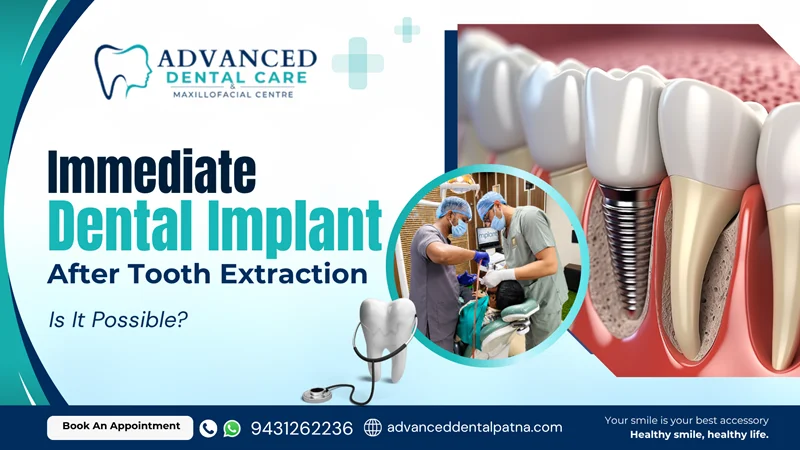
If a tooth needs to be removed because of severe decay, infection, trauma, or other dental problems, one of the common questions patients ask is: can a dental implant be placed immediately after tooth extraction?
The answer is yes, in selected cases. This treatment is known as an immediate dental implant, where the damaged tooth is extracted and the implant is placed during the same appointment. However, immediate dental implant after tooth extraction is not suitable for everyone. The condition of the tooth, gums, jawbone, and surrounding tissues must be carefully evaluated before treatment.
At Advanced Dental Care & Maxillofacial Centre, treatment planning for dental implants is guided by the individual patient’s oral health, bone condition, and long-term functional and aesthetic requirements.
What Is an Immediate Dental Implant?
The conventional method of placing a dental implant in Patna involves extracting the tooth and allowing the site to heal prior to placing the implant. This time frame allows for several weeks or even months, depending on the individual case.
Dental implants are placed immediately into the extraction socket during the tooth extraction and often constitute the only treatment required for immediate teeth replacement during the same dental treatment session, provided clinically appropriate.
The general treatment sequence may look like:
Tooth Extraction → Implant Placement → Healing & Osseointegration → Final Crown
The immediate dental implant after tooth extraction could also have several advantages, like performing only one surgery for a tooth that has just been extracted and thus preserving the surrounding oral tissues as much as possible and keeping the dental arches as natural as possible.
However, it is crucial to remember that immediate dental implants after tooth extraction are carried out on a case by case basis and are not always the quickest solution
When Can a Dental Implant Be Placed Immediately After Extraction?
Immediate dental implant after tooth extraction is indicated when there is sufficient healthy bone to obtain initial implant stability.
During the evaluation, the dental team may assess:
- The amount and quality of the jawbone.
- Condition of the gums and surrounding tissues.
- Presence and severity of infection.
- Condition of the tooth being extracted.
- Position of the surrounding teeth.
- Bite and functional requirements.
- Overall oral hygiene and health.
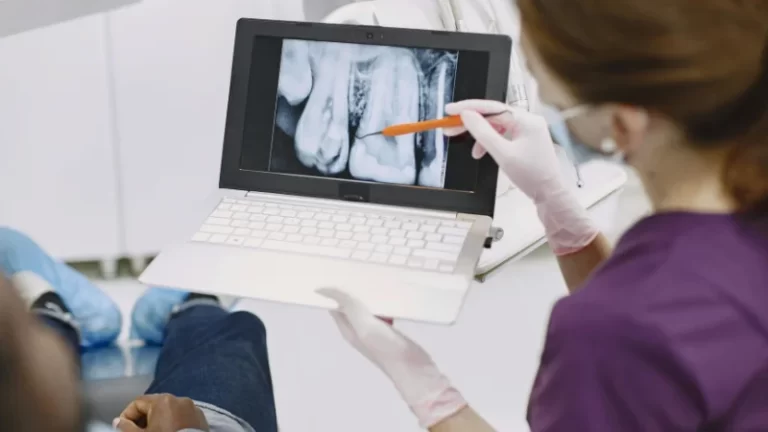
Advanced imaging, including X-rays or CBCT scans, can be used to establish the precise bone structure and plan the placement of the dental implants.
Can an Implant Be Placed If the Tooth Has an Infection?
The presence of infection does not necessarily exclude immediate dental implant placement but requires careful consideration.
>If there is a significant amount of infection, inflammation and/or bone destruction then immediate placement may not be the best option. In severe cases of infection or complications, it might be necessary to allow time for the infection to be brought under control and for the extraction site to heal prior to placement of dental implants.
It is important to have an implant placed immediately in a dental reconstructed environment only after a thorough examination has taken place.
What Happens During Immediate Implant Placement?
Immediate dental implant after tooth extraction might be an option following tooth removal, depending on the condition of your oral health and bone. Though, if you require emergency dental services, our emergency dentists can assess the condition of your tooth and help decide the best course of action.
Dental Examination and Imaging
To plan the dental implant treatment after tooth extraction, we first need to assess the tooth, the gums, the bone, the bite and all the surrounding tissues. An X-ray will also indicate whether sufficient bone is present to allow the dental implant to be stabilised in the jaw.
Careful Tooth Extraction
The doctor extracts all the teeth as gently as can be done, in order to spare as much as possible of the bone and soft tissue which surrounds the teeth. This also permits the placement of implants at the same time.
Preparation of the Implant Site
The socket of the extracted tooth is assessed and prepared for the dental implant. Additional measures, for example bone grafting, may be needed to ensure sufficient support of the implant.
Implant Placement
The implant is positioned according to the dental plan inside the jaw and the aim is to best primary stability for immediate implantation. This way, guaranteeing a good healing process and foundation for the prosthetic tooth.
Healing and Osseointegration
Following placement of the implant, time is allowed for the implant to integrate with the surrounding bone. This process is referred to as osseointegration and is crucial to the long term success of the implant.
Placement of the Final Crown
Once the dental implant has completely fused to the jaw bone, a custom dental crown can be placed on the dental implant, restoring the appearance and function of the natural tooth. Thus, the crown gives a natural-looking finish as well as assisting you to chew and speak well.
The success criteria for immediate dental implant after tooth extraction include proper planning, healthy gums and strong support of the bone. Ask your dentist if you are the right candidate for this treatment to get the best results.
What Are the Benefits of Immediate Dental Implants?
Immediate dental implant after tooth extraction is beneficial for a group of patients in order to provide several advantages.
- Fewer dental appointments as the tooth is extracted and the dental implant is placed at the same time.
- Immediate dental implant after tooth extraction allows the implant to be placed right after tooth extraction, without a waiting period.
- Placing the implant soon after tooth extraction helps preserve the extraction site and provides support for the planned tooth restoration
- Maintenance of the soft tissue contour of the area in a way that is appropriate for immediate dental implant placement in visible areas of the dentition.
- The planned restoration can be prepared at the time of implant placement, depending on the implant’s stability and the patient’s oral condition.
Quick reminder that immediate implantation may not actually be the best for each patient. In some cases, staged or delayed implant placement may be more predictable.
When May Immediate Implant Placement Not Be Recommended?
Immediate dental implant after tooth extraction is not recommended in the following situations:
- Significant bone loss.
- Severe or uncontrolled infection.
- Poor gum health.
- Insufficient bone for primary implant stability.
- Certain uncontrolled medical conditions.
- Poor oral hygiene.
- Extensive damage to the surrounding tissues.
In case, immediate placement is not feasible, then a dentist who is providing tooth extraction in Patna may suggest waiting for healing to occur in the first place, with bone regeneration if needed and proceeding with implants afterward.
How Advanced Dental Care & Maxillofacial Centre Helps
At Advanced Dental Care & Maxillofacial Centre, immediate dental implant treatment begins with careful diagnosis and treatment planning.
Dr. Kumar Tathagat Singh, MDS (Oral & Maxillofacial Surgery) has extensive experience with oral and maxillofacial surgical procedures, dental implant placement, jaw and face trauma, impacted teeth and other complex oral surgery procedures.
With over 16 years of dental surgical experience, Dr. Kumar Tathagat Singh has extensive expertise in complex dental implant procedures. He also handles challenging cases involving bone loss, impacted teeth, and oral surgery in very effective manner.
We, first, assess the condition of the tooth as well as the surrounding bone. And then determine if immediate placement is appropriate or a staged approach to the needed. This ensures optimal stability and good oral health to our patients.
The treatment plan may involve:
- Detailed clinical examination.
- Dental imaging and CBCT evaluation when required.
- Assessment of bone quantity and quality.
- Careful tooth extraction.
- Immediate dental implant after tooth extraction when clinically appropriate.
- Bone grafting or other supporting procedures when required.
- Planning for the final dental crown.
- Follow-up during the healing and implant integration period.
The immediate dental implant does not only consist of placing the implant immediately. Though, the dentist at one of the best dental clinic in Patna has to choose the most appropriate approach to obtain a suitable and stable function of the tooth.
Final Thoughts
Can you put an implant in after tooth extraction? Yes, if the situation is right. Immediate dental implant placement after tooth extraction can reduce overall treatment time. It can also help preserve the surrounding gum tissue and jawbone.
Not every tooth extraction can be replaced with this method. You need to take into account the condition of the gums and bone, the presence of infection, as well as the stability of the implant. For this reason, a dental checkup and the right imaging are recommended.
If you would like to learn more about immediate dental implant placement, contact Advanced Dental Care & Maxillofacial Centre. Book an appointment with our dental team to discuss your treatment options.