
Book Appointment Now


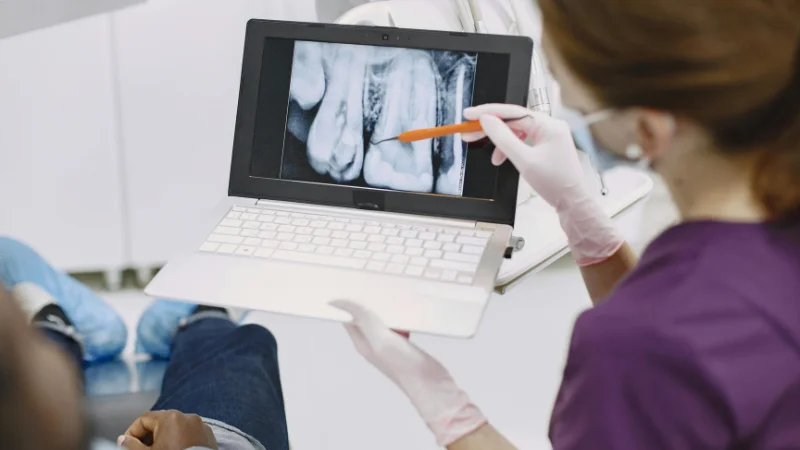
A healthy smile begins with good oral health but there are lots of dental problems that cannot be seen during an oral examination. These include interdental decay, root surface abscesses, bone loss and impacted wisdom teeth.
In order to diagnose these problems and treat them, dental X-rays are essential to diagnose hidden dental problems and plan dental treatment.
In this blog, we will explore what a dental X-ray is, the different types, their benefits, and when your dentist might suggest getting one.
What Is a Dental X-Ray?
A dental X-ray is a diagnostic tool that uses a low amount of radiation to make pictures of your teeth, tooth roots, jawbone, and surrounding structures. These pictures allow your dentist to see things he or she cannot see by looking into your mouth with the naked eye.
As part of dental diagnostics, dental X-rays are regularly used for the purpose of dental care and prevention. The dental images enable dentists to assess teeth and the surrounding bone in greater detail and make the best possible treatment decisions.
In modern dental clinics X-rays are taken with digital X-ray systems. These images are shown on the computer screen of the dentist and can be magnified. In this way the dentist can focus on a small area of interest.
Why Is a Dental X-Ray Important?
Dental X-rays help us to identify hidden dental problems before they become more serious and need more complicated treatment. Let’s take a closer look at how they can help detect these issues.
1. Detecting Cavities Between Teeth
Some cavities develop between adjacent teeth or even under fillings. A simple visual inspection of teeth is not sufficient to detect these types of cavities. Dental X-rays can however help detect them at the right time for treatment to be proposed.
2. Identifying Tooth Infections
An infection of the pulp of a tooth can cause changes in the bone around the root of the tooth. An X-ray can be used to check for these changes and further investigate the need for treatment, such as root canal treatment.
3. Examining Tooth Roots and Jawbone
Dental X-rays can also be used to check on the tooth roots and the supporting jawbone. This could be the case where there is suspicion of periodontal disease, jawbone loss, recent injury to the jaw or change to a tooth that has previously had dental treatment.
4. Checking Wisdom Teeth
X-rays of the wisdom teeth can show whether they are coming in trapped in the gum or coming in at an unusual angle. Further, dentists decide whether the wisdom teeth need monitoring or removal is the safer option.
5. Planning Dental Treatments
A number of dental treatments need to be planned using Dental X-Rays. Examples of these are root canal treatment, extraction of teeth and dental implants.
Overall, a dental X-ray gives your dentist a clearer picture of what’s happening beneath the surface, helping them spot problems early and plan the right treatment.
What Are the Different Types of Dental X-Rays?
Different dental X-rays are used for different diagnostic purposes.
- Bitewing X-rays: These X-rays show the crown of the upper and lower teeth and the areas between them. This type of image is often used to see if there are cavities between teeth and to measure the height of the gum and bone around teeth.
- Periapical X-rays: These X-rays are used to look at an individual tooth or a small group of teeth. They contain images of the tooth’s crown, roots and the surrounding bone and structures. They are particularly useful in diagnosing root infections and dental injuries.
- Panoramic X-rays: This X-ray type shows a broad section of the upper and lower jaw, including most of the teeth and also the wisdom teeth. We use this type of image for the diagnosis of impacted teeth and for other conditions of the jaw.
- CBCT scans: CBCT scans (Cone beam computed tomography) are three-dimensional images of the selected part of the teeth and jaws. These are usually recommended for complicated cases including dental implant cases where normal 2D images are not sufficient to make a proper diagnosis.
When choosing an image, your dentist will pick one or other that best suits your dental symptoms and history.
Are Dental X-Rays Safe?
Dental X-rays used in dental treatments contain ionising radiation, and therefore should be used at the lowest dose necessary to make adequate diagnosis.
Dental X-rays involve relatively low levels of radiation when clinically justified and taken using the appropriate technique. Your dentist will take into account your age, symptoms, previous X-rays, and individual dental needs before taking any dental X-rays.
Let your dentist know if you are pregnant or even if you think you might be pregnant. You will be assessed as to whether you require any dental X-rays and if so, appropriate measures will be taken to minimize exposure to radiation.
X-rays shouldn’t be taken at every dental appointment. Each patient should be assessed individually to determine if an X-ray is needed.
How Often Should You Get a Dental X-Ray?
You should not expect your dentist to work to a standard schedule. Many patients have active decay, past dental problems or have special requirements. They will need X-rays more frequently than patients with good oral health.
Your dentist will assess your needs for more dental X-rays based on your oral examination, your medical and dental history, your decay risk and your previous dental X-ray images.
Conclusion
Dental X-rays are used by your dentist to reveal surfaces and problems within your teeth and jaws which cannot be seen by simple inspection. They can show up any early signs of decay, abscesses at the root of teeth, changes in the bone of the jaw, and other problems including wisdom teeth which are impacted.
Dental X-rays are used to diagnose tooth decay, gum disease and other problems of the teeth and jaws.
If you have a persistent problem with tooth pain, or swelling of the face, we would examine your mouth and advise whether an X-ray is required. We would also explain the X-ray findings and recommend any further treatment.